

Using your Embrace
A guide to wearing, adjusting, and caring for your carrier. Take your time — learning a new carrier takes a few tries, and that is completely normal.
A few important notes on safety
Please read through this section before using your Embrace for the first time. Keep this guide for future reference.
- Fall hazard Babies can fall through a wide leg opening or out of the carrier. Adjust the leg openings to fit your baby's legs snugly. Before each use, check that all buckles, snaps, and straps are secure.
- Suffocation hazard Babies under four months can suffocate if their face is pressed too tightly against your body. Do not strap your baby too tightly. Allow room for head movement. Keep your baby's face visible and free from obstructions at all times.
- Check on your baby often Make sure your baby's chin is not resting on their chest, as this can restrict breathing.
- Move with care Take extra care when leaning or walking. Never bend at the waist; bend at your knees instead.
- Use within the tested range The Mirevella Embrace is suitable for babies between 3.6 kg / 8 lbs and 20 kg / 44 lbs, from newborn through approximately 36 months.
The Mirevella Embrace is tested to ASTM F2236-24 and CPSIA standards.
Sizing the body panel
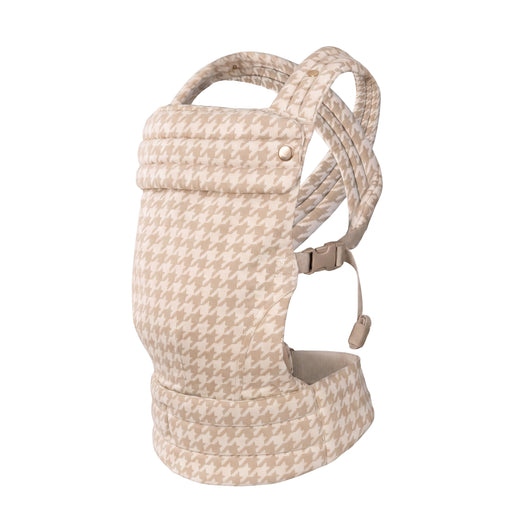
The Embrace's body panel adjusts to four sizing positions, depending on the length and weight of your baby. The settings are controlled by snaps hidden inside the waistbelt.
For optimal support, the body panel's fabric should always run from your baby's knee to knee. Their knees should sit slightly higher than their bottom — the "M" position.

From 3.6 kg / 8 lbs up to 7 kg / 15 lbs
Slide the body panel inwards to the smallest setting and attach one snap on each side. Leave the remaining snaps unused.

Up to 9 kg / 20 lbs
Slide the body panel to a wider setting and attach two snaps on each side. Leave the remaining snaps unused.

Up to 11 kg / 24 lbs
Slide the body panel to an even wider setting and attach three snaps on each side. Leave the remaining snaps unused.

Up to 20 kg / 44 lbs — or from 6 months for facing-out carry
Slide the body panel to the widest setting and attach all snaps on each side.

Finding the correct fit
When you adjust the body panel, always check that your baby's knees sit higher than their bottom and that the fabric supports their thighs. This is the "M" position, shown below.

The "M" position
When the body panel is sized correctly, your baby sits in the M position — knees slightly higher than their bottom, thighs fully supported by the fabric.
Too narrow
If your baby's thighs are not fully supported, the body panel should be adjusted to a wider setting.
Too wide
If the fabric reaches beyond your baby's knees, the body panel should be adjusted to a narrower setting.
Adjusting the neck cushion
The neck cushion adjusts to three different positions, depending on your baby's age and the support they need.
There are button holes and elastic loops on both sides of the neck cushion. Attach it to the gold-finished buttons on the carrier's body panel or shoulder straps. The button holes give a tighter fit and more support; the elastic loops give a looser fit with more room to move.

Folded down on the inside
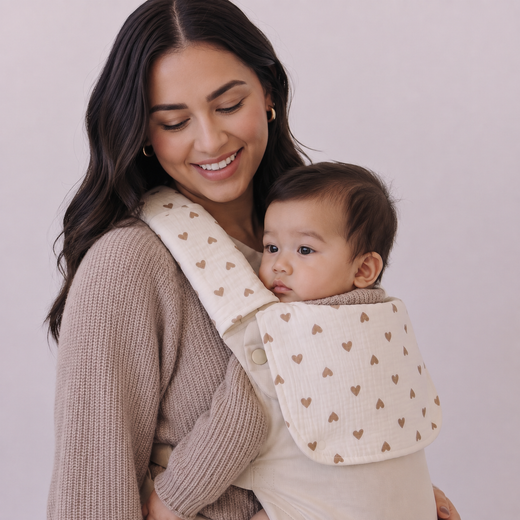
For the youngest babies, fold the neck cushion down so it sits softly between baby and the body panel.
Folded down outside, or up for extra support
Use the outside-folded position for everyday wear. Lift the cushion up when your baby needs additional neck support — for example, while sleeping.
Arms out, cushion folded outside
For older babies who prefer their arms free, fold the cushion down on the outside.
Front carry, facing in
The most versatile way to wear your Embrace, suitable from newborn through approximately 36 months. Follow each stage in order — the first time will feel slow, the fifth will feel like nothing.
Putting on the waistbelt
- Position the waistbelt with the warning label facing inwards and the body panel centered on your body.
- Take the male buckle (including the extra strap length) through the elastic safety loop.
- Secure the waistbelt by fastening the buckle until it clicks.
- Tighten the waistbelt by pulling on the adjustable black strap until it sits snugly above your hips. Tuck the excess length into the storage loop.

Attaching the left shoulder strap
- Make sure both shoulder straps are extended to their longest setting and the buckles are unfastened. Lift the body panel up by placing the left shoulder strap on your left shoulder.
- Pull the left shoulder strap across your back.
- Take the entire male buckle of the left shoulder strap (including the extra strap length) through the elastic safety loop attached to the female buckle on the right side of the body panel.
- Feed the male buckle into the female buckle on the right side of the body panel until it clicks.

Placing your baby in the carrier
- Pick up your baby and position them on your right side.
- Use your right hand to support your baby facing inwards. With the other hand, slip your baby's right leg between the panel and your body.
- Use your left hand to support your baby, and the other to slip your baby's left leg underneath the strap already buckled to the side of the body panel.
- Pull the right shoulder strap up, lifting the body panel behind your baby's back.

Attaching the right shoulder strap
- While still holding your baby with your left hand, pull the right shoulder strap over your right shoulder.
- Pull the right shoulder strap across your back.
- Take the entire male buckle (including extra strap length) through the elastic safety loop. Feed the male buckle into the female buckle on the left side of the body panel until it clicks.
- Pull the body panel up from its upper edge to make sure there are no pleats.

Tightening and final adjustments
- Tighten both side straps simultaneously. Make sure your baby is comfortable and not pressed too tightly against your body. Allow room for head movement.
- Ensure your baby's back is slightly rounded while sitting in the carrier. Your baby's bottom should sit deep in the body panel, just above the waistbelt.
- Reduce any excess strap length by rolling up the strap and securing it with the elastic storage loop attached to the end.

Front carry, facing out
Suitable from 6 months, once your baby has steady head and neck control. The setup is the same as front carry facing in, with two adjustments to the body panel and neck cushion.

Body panel
Adjust the body panel to the widest setting with all snaps engaged on each side. This keeps your baby in the M position while facing outward.
Neck cushion
Fold the neck cushion down on the outside and attach it to the body panel using the button holes. Your baby's arms should rest comfortably over the cushion on either side.
Back carry
The back carry transitions from front carry, facing in. Suitable once your baby has good head and neck control and can sit unassisted.
Transitioning your baby to your back
- Start with your baby secured in front carry, facing in. The waistbelt should sit snugly above your hips.
- With your left hand, hold both shoulder straps together near your baby's neck. Allow room for head movement.
- Slip both shoulder straps off your shoulders, continuing to hold them in your left hand to support your baby. The straps remain buckled to the body panel.
- Use your right hand to hold the waistbelt and rotate the carrier around your waist, moving your baby from front to side, then to your back.
- Lean forward slightly so your baby can rest against your back. Keep them secure by holding both shoulder straps with your left arm.
- Maintaining a slight forward lean, take the right strap into your right hand and the left strap into your left hand.

Slipping your arms through
- Slip your right arm through the right strap as if putting on a backpack. Keep holding it with your right hand.
- Slip your left arm through the left strap. Keep holding it with your left hand.
- Ensure your baby's arms can move freely.
- Tighten both side straps simultaneously. Your baby should be comfortable and not pressed too tightly against your body.

Tightening the waistbelt
- Tighten the waistbelt by pulling on the adjustable black straps until it sits snugly above your hips.
- Tuck the excess strap length into the storage loop.

Final check
- Reduce excess strap length by rolling up the strap and securing it with the elastic storage loop.
- Allow room for your baby's head movement. Ensure their back is slightly rounded while sitting in the carrier, and their bottom is deep in the body panel just above the waistbelt.
Taking off the back carry
- While holding the left strap in your left hand, grab the right strap from your right shoulder and hold it tight. Slip your right arm through as if taking off a backpack. Keep holding the right strap up high above your shoulder.
- Repeat on the left side, holding the straps tightly above your shoulders and your baby's head.
- With your left hand, hold both straps together around your baby's neck. Allow room for head movement.
Removing your baby
To take your baby out without unbuckling, follow the sequence below.
- Slightly loosen the right shoulder strap buckled to the side of the body panel. Do not loosen the left shoulder strap.
- With your right hand, slightly loosen the waistbelt without unbuckling it, to allow room for movement.
- Hold both straps together with your left hand. Use your right hand to rotate the carrier around your waist and position your baby on your left side.
- Holding both straps with your left hand, support your baby with your right hand and release the straps.
- Use your free hand to place one strap at a time behind your baby's back. Your baby is free to go.
Care & cleaning
Your Embrace is made to be used daily and washed when it needs it. A few simple practices will keep it looking and feeling like new.
Washing
Machine wash cold on a gentle cycle. Use a mild detergent without bleach or fabric softeners. Close all buckles before washing to protect the fabric and other garments.
Drying
Lay flat or hang to dry. Do not tumble dry. Reshape the body panel and shoulder straps while damp so they dry evenly.
Storing
Store your Embrace in the dust bag it came with, away from direct sunlight when not in use.